Showing posts with label Women. Show all posts

Monday, September 30, 2019

Who was Rahab? And what's the deal with conflicting geneaolgies?!

Many of us noticed in the very first page of Matthew the listing of just a few women. One of those women, Rahab, draws particular attention because she was thought to be a prostitute and she was not Jewish. How interesting that she should be named in the genealogy of Jesus when so many others are not. Is there a message to be found in the inclusion of these particular few?

Rahab is listed in the Jewish Women's Archive (Rahab: Midrash and Aggadah) as, "among the four most beautiful women the world has ever known: Sarah, Rahab, Abigail and Esther," and among the prominent conversions stories of the Old Testament.
"The Rabbis deduced from the story of Rahab the superiority of repentance over prayer, for Moses prayed exceedingly, but God did not accept his entreaty to enter Erez Israel, while the repentance of Rahab the harlot was accepted, and seven kings and eight prophets issued forth from her."
The Jewish Midrash also teaches that Rahab married Joshua, thus the seven kings and eight prophets that descended from her. This conflicts with the genealogy of Matthew, which states, "Salmon the father of Boaz, whose mother was Rahab," which would indicate that Rahab married Salmon. In either case, a line of kings descend from her, including, eventually, Jesus. 

 This brings us to the question of what to make of the genealogies of Jesus found in both Matthew (chapter 1) and Luke (chapter 3), because they most certainly do not agree. Bible.org has an article that helps to make some sense of this: The Genealogy of Jesus. Go check it out!

Tuesday, January 16, 2018

Violence Against Women in the Torah

As we begin our study of Cross Vision, we are faced immediately with the "elephant" in the Christian living room. Violence is ubiquitous in the Old Testament stories, and, even more alarming, much of the violence is sanctioned or even perpetrated by God. Our Old Testament scriptures were part of the Jewish tradition long before they became a part of ours. So, it seems prudent to also keep our eyes and ears out for Jewish interpretations of the same texts. With that in mind, this article seems relevant: Violence Against Women by Judith Plaskow from The Torah: A Women's Commentary. Of note:
It is striking that throughout the portion, God is implicated in the violence in the text. Except in the case of Lot’s willingness to sacrifice his daughters, God carries out or commands the violence (Sodom and Gomorrah; Isaac) or supports it (Abraham and Sarah; Sarah and Hagar). The representations of violence that the text holds up to us are ones on which the human and divine levels mirror each other. There is no cosmic relief, so to speak, from the reality of violence.
"There is no cosmic relief..." It's hard not to feel the weight of that after reading the first chapter of Boyd's book. We are faced with a very real question, one that has caused honest and educated theologians to lose their faith.  It takes both humility and courage to face this issue. Let us hold one another in prayer as we read and study and discuss.

Tuesday, December 20, 2016

Additional Reading for Women in the New Testament

If you're looking for additional notes on the topics covered in Kenneth Bailey's lectures, you can find a lengthy article that he wrote for Theology Matters here: Women in the New Testament: A Middle Eastern Cultural View. In this article, you'll be able to find some of the information that goes by too fast to get good notes from the video. Check it out!

Wednesday, December 14, 2016

Mary and Mangers

Last week I shared Nadia Bolz-Weber's sermon on Mary, the mother of Jesus. You can find that sermon here: Sermon on Mary. An especially poignant piece of that sermon for me was this:
"She [Mary] got something I really struggle to understand: that getting a blessing is not the same as getting a present. She said yes not based on the expectation of things being awesome for her but based on the expectation that God can create something out of nothing. And the thing is: we just never know simply based on how our life feels if it is filled with blessing or not."
What we don't really know about Mary's story, despite all the sermons and nativities and paintings, is how or where or with whom she labored and gave birth. Kenneth Bailey and other scholars have raised some questions about our traditional Western interpretation of the word "manger" and our understanding of "inn."
"The text tells us, “She gave birth to her first son, wrapped him in swaddling clothes and laid him in a manger.” The traditional understanding of this verse in the Western world moves along the following path. Jesus was laid in a manger. Mangers are naturally found in animal stables. Ergo, Jesus was born in a stable. However, in the one-room peasant homes of Palestine and Lebanon, the manger is built into the floor of the house. The standard one-room village home consists of a living area for the family (Arabic mastaba), mangers built into the floor for feeding the animals (mostly at night), and a small area approximately four feet lower than the living area into which the family cow or donkey is brought at night (Arabic ka’al-bayt)." (Kenneth Bailey's The Manger and The Inn)
And from the same article...
"In Luke 2:7 kataluma is best understood as “guest room.” ... Joseph and Mary arrive in Bethlehem. They find shelter with a family whose separate guest room is full, and are accommodated among the family in acceptable village style. The birth takes place there on the raised terrace of the family home, and the baby is laid in a manger."
How might it change things, if we consider that Jesus was born, not in isolation and loneliness, but in community? What does it mean if Mary's story is not one of bravely facing the unknown alone (well, with Joseph...but he often gets a back seat, too...)? Within our own cultural context, are we actually more comfortable with the "brave and alone" story than we are with a story that involves community? Personally, I think it's a bit of a miracle that Mary was brought out of a potentially dangerous and extremely isolating circumstance (carrying a pregnancy and giving birth in her own community as an unwed mother) to a place where the Messiah could be born safely and in peace, among his own people.

Sunday, November 27, 2016

A look at Proverbs 31:10

At our last meeting we discussed Proverbs 31. Some questions came up about the use of the word "wife" in this passages, and it turns out that the Hebrew word used in Proverbs 31 for wife is "ishshah," which can be translated either "wife" or "woman." For an exposition of this passage, check out "The Valiant Woman" at the Theology of Work Project. Of special note is their commentary on the word translated variously as virtuous, excellent, noble, or capable in Proverbs 31:10:

"Who can find a virtuous woman?" (King James Version)

"An excellent wife who can find?" (English Standard Version)

"A wife of noble character who can find?" (New International Version)

"A capable wife who can find?" (New Revised Standard Version)

The commentator notes:
When applied to a man, this same term is translated “strength,” as in Prov. 31:3. In a great majority of its 246 appearances in the Old Testament, it applies to fighting men (e.g., David’s “mighty warriors,” 1 Chronicles 7:2). Translators tend to downplay the element of strength when the word is applied to a woman, as with Ruth, whom English translations describe as “noble” (NIV, TNIV), “virtuous” (NRSV, KJV) or “excellent” (NASB). But the word is the same, whether applied to men or women.
The Orthodox Jewish Bible translates the verse in this way:

"Who can find an aishes chayil (a woman of valor, an excellent wife Prov 12:4)?"

This single line is an excellent example of how important it can be to look into several translations of scripture and to always keep it in the forefront of our minds that the original language of the Bible is not English.

Wednesday, November 16, 2016

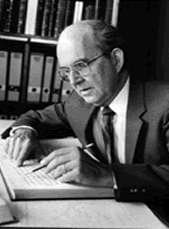
Who is Kenneth E. Bailey?


Kenneth E. Bailey is the lecturer for the Women in the New Testament series. For a beautifully written biography, see this link: https://godswordtowomen.org/bailey.htm.


I have made several attempts to distill this biography and the one found here: https://shenango.org/bailey/ into Five Fast Facts, and have been completely unable to do so. The Baileys seemed to have lived more than one life, there are so many things to say about them!

Christianity Today describes Mr. Bailey as "the scholar who made Jesus Middle Eastern again." His parents were missionaries in Egypt, and Mr. Bailey, in turn, spent much of his life in ministry in Egypt, Lebanon, Cyprus, and Jerusalem with his wife and two children (Sara and David).  He was a professor, speaker, and author in both the Middle East and the United States. In addition, he has an extensive teaching video collection. His wife, Ethel Bailey, was also quite accomplished. She was Dr. Jonas Salk's research assistant at the time that Dr. Salk discovered the polio vaccine. She taught microbiology in Arabic, typed Mr. Bailey's manuscripts, and was the recording secretary for the school board of the American Community School in Beirut. Dr. Kenneth Bailey died on May 23rd, 2016 at the age of 85.

Thursday, November 3, 2016

What's Brewing Next?

In the coming weeks, we'll be taking some time out of the Covenant Study to do a six week lecture series on Women in the New Testament by Kenneth Bailey. I encourage you to think of this as a way of expanding the Covenant Study. We've made it from the Covenants of Noah, Abraham, and Moses...to the Covenant of Jesus...and the life of the early church wrestling with how to live within that Messianic Covenant. The Women of the New Testament lecture series should be a nice way to stop and spend a bit of extra time on how the New Testament addresses women specifically. I'm excited that this week's Covenant Study episode led us right into this next study! Lecture 4 will deal directly with the passage from 1 Corinthians 11!

The study guide for the Women in the New Testament lecture series can be found online for FREE. I recommend printing it. It is 18 pages long. If you have any trouble, please let me know, and I will print you a copy. See the study guide here: https://shenangopresbytery.files.wordpress.com/2013/10/women.pdf


Tuesday, April 14, 2015

Women in Judaism

Last week we briefly mentioned how, unlike many other cultures throughout history, Jewish girls were educated alongside boys in Beth/Bet Sefer until they were 12 or 13, meaning that girls and women were often just as educated as their male counterparts. Only some boys/men went on to study more in Beth/Bet Midrash after finishing Bet Sefer. Given that discussion, I thought you all might appreciate an article from Judaism 101 about the "Role of Women" in Judaism. Here are some interesting snippets:
The position of women is not nearly as lowly as many modern people think; in fact, the position of women in halakhah (Jewish Law) that dates back to the biblical period is in many ways better than the position of women under American civil law as recently as a century ago.
The equality of men and women begins at the highest possible level: G-d. In Judaism, unlike traditional Christianity, G-d has never been viewed as exclusively male or masculine. Judaism has always maintained that G-d has both masculine and feminine qualities.
The rights of women in traditional Judaism are much greater than they were in the rest of Western civilization until the 20th century. Women had the right to buy, sell, and own property, and make their own contracts, rights which women in Western countries (including America) did not have until about 100 years ago. In fact, Proverbs 31:10-31, which is traditionally read at Jewish weddings, speaks repeatedly of business acumen as a trait to be prized in women (v. 11, 13, 16, and 18 especially).
The following passage is perhaps the best explanation for why it was so important for girls and women to be educated in the Torah:
There is no question that in traditional Judaism, the primary role of a woman is as wife and mother, keeper of the household. However, Judaism has great respect for the importance of that role and the spiritual influence that the woman has over her family. The Talmud says that when a pious man marries a wicked woman, the man becomes wicked, but when a wicked man marries a pious woman, the man becomes pious.
The entire article can be read here: http://www.jewfaq.org/women.htm.